





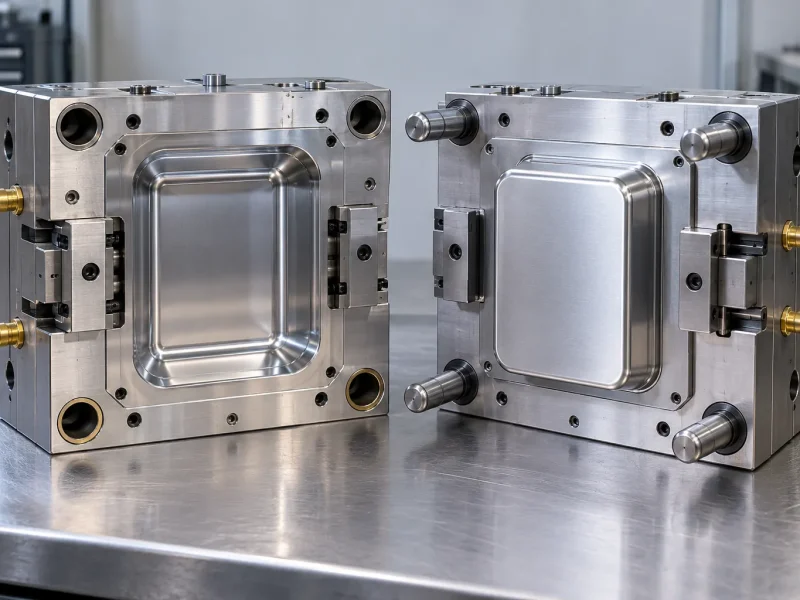
The price of an injection mould is set mainly by the size and complexity of the part, the number of cavities, the mould steel, the runner system, the surface finish and the tolerances. Because every custom mould is different, a fair price can only be given after the part has been reviewed – but knowing what drives the cost helps you compare quotations and decide where to save.
1. Part size and mould size
A larger part needs a larger mould base, more steel and a larger press for trials and production. A bumper or a chair mould weighs many tons; a mould for a small clip fits on a desk. Size affects material, machining hours and handling at every step.
2. Complexity: undercuts, slides and lifters
Features that cannot be released in the opening direction of the mould – side holes, snap hooks, internal threads – need slides, lifters or unscrewing mechanisms. Each moving action adds design, machining, fitting and maintenance. A DFM review often finds undercuts that can be removed by a small design change.
3. Number of cavities
A multi-cavity mould costs more to build but produces several parts per cycle, so the cost of every part falls. The right cavity number depends on annual quantity: high-volume disposables justify 16, 32 or 48 cavities, while a few thousand parts a year are often best made in a single-cavity or family mould.
4. Mould steel and mould life
Pre-hardened steels such as P20 or 718 are quicker to machine and suit medium volumes. Hardened H13 or stainless S136 cost more but last longer and resist wear and corrosion. Expected mould life – from 50,000 to 1,000,000 shots in our moulds – is the main factor in the choice. See our mould steel selection guide.
5. Runner system
A hot runner adds cost to the mould but saves material and cycle time, which pays back at high volumes. A cold runner is cheaper to build and often better for low volumes or frequent colour changes. Read more in hot runner vs cold runner moulds.
6. Surface finish and texture
A standard machined finish is the least expensive. Mirror polishing for clear or high-gloss parts, and textures to VDI or MT standards, add hours of skilled work and may require a better-polishing steel.
7. Tolerances and engineering
Tight tolerances on many dimensions mean more precise machining, more inspection and sometimes extra trials. We work to ISO 20457 / DIN 16742 tolerance groups as a guide and agree which dimensions are really critical during DFM.
8. Production volume and mould class
A mould for 500 prototype parts and a mould for a million parts are different tools. Classifications such as the SPI mould classes 101–105 describe this link between volume, steel and construction.
Cost drivers at a glance
| Factor | Raises the mould price when… | Effect on part cost |
|---|---|---|
| Part size | the part is large or deep | Larger press, longer cycle |
| Complexity | undercuts need slides, lifters or unscrewing | Can lengthen the cycle |
| Cavities | more cavities are added | Lower cost per part |
| Steel | hardened or stainless steel is used | Longer life, fewer repairs |
| Runner system | a hot runner is used | Less waste, shorter cycle |
| Surface finish | mirror polish or texture is required | Better appearance |
| Tolerances | many dimensions are tight | More inspection |
How to lower the total cost
- Ask for a DFM review before the order – removing one undercut can save a slide.
- Choose the cavity number from your real annual quantity, not the maximum.
- For low volumes, consider a family mould or test the design with prototypes first.
- Keep tight tolerances for the dimensions that matter.
- Compare cycle time, scrap rate and mould life, not only the tooling price.
What we need for a quotation
A 3D model (STEP or IGES preferred) or drawing, the material, annual quantity, colour and finish, and any critical dimensions or standards. Every quotation includes a DFM review. Learn how we build moulds on our moulds and tooling page and in our mould making process.
Frequently asked questions
Why do mould quotations from different suppliers differ so much?
Suppliers often quote different moulds: different steel, cavity numbers, runner systems, mould bases and expected life. Compare these details line by line – a cheaper quote may simply describe a shorter-lived tool.
Is a cheaper mould a false economy?
Often. A mould that needs extra trials, runs a slower cycle or wears out early costs more over the life of the product than a better tool.
Who owns the mould once it is paid for?
You do, together with the design data. You can keep it with us for production or move it.
Have a part to discuss? Send your drawing or 3D file through our inquiry form – our engineers reply with a quotation and DFM suggestions.