





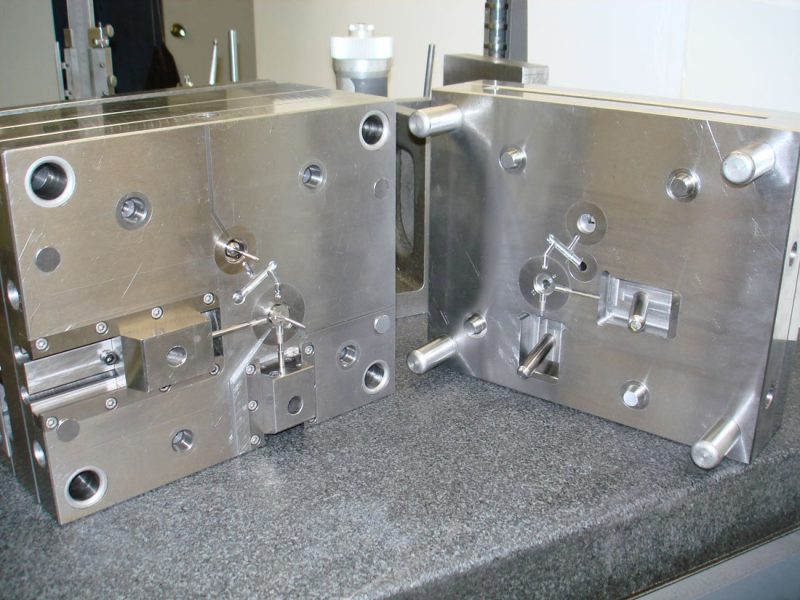
Choose the mould steel by production volume, the resin and the surface finish you need. Pre-hardened P20 or 718 suits medium volumes, hardened H13 suits long runs and glass-filled or abrasive resins, and S136 or NAK80 is used where a high polish or corrosion resistance is required.
The five steels we use most
| Steel | Supplied as | Typical hardness* | Best for |
|---|---|---|---|
| P20 (1.2311) | Pre-hardened | about 28–34 HRC | Medium volumes, large moulds, easy machining |
| 718 (1.2738) | Pre-hardened | about 30–36 HRC | Medium to high volumes; more even hardness and better polish than P20 in large blocks |
| H13 (1.2344) | Hardened | about 48–52 HRC | Long runs, glass-filled and abrasive resins, high mould temperatures |
| S136 (stainless) | Hardened or pre-hardened | about 48–52 HRC hardened | High polish, clear parts, corrosion resistance, medical parts |
| NAK80 | Pre-hardened | about 37–43 HRC | Mirror polish and fine texture without heat treatment |
* Typical values. The exact steel grade and hardness for each mould are written into our quotation, and material certificates are available.
Pre-hardened or hardened?
Pre-hardened steels arrive from the mill ready to machine, so moulds are faster to build and easier to modify. Hardened steels are machined, heat-treated and finished; they take longer but resist wear far better. For long production runs the extra build time is quickly repaid.
How the resin changes the choice
- Glass-filled PA, PBT and other abrasive resins wear soft steel quickly – use hardened H13.
- Clear parts in PC or PMMA need cavities that polish to a mirror – S136 or NAK80.
- Corrosive resins and humid conditions favour stainless S136.
- Commodity resins such as PP and ABS at medium volumes run well in P20 or 718.
See our overview of plastic materials for more on resins.
Mixing steels in one mould
A mould does not have to be made from one steel. Cavity and core inserts can be made from a harder or better-polishing steel while the mould base uses a standard grade. We build on LKM, HASCO or DME mould bases, so standard components and spare parts are easy to source.
Steel and mould life
Our moulds are built for 50,000 to 1,000,000 shots, depending on the steel, hardness and cooling we agree. The expected life is stated in the quotation – a useful line to compare between suppliers, as explained in our guide to injection mould cost.
Frequently asked questions
Which steel is used for medical moulds?
Medical moulds often use stainless S136 for its polish and corrosion resistance, or hardened steels for high-cavitation, long-running tools. The choice follows your volume and quality requirements.
Can you use the steel brand or grade I specify?
Yes. We build to the steel your specification calls for and provide material certificates.
Is a harder steel always better?
No. Harder steels last longer but cost more and take longer to machine. For medium volumes, a pre-hardened steel is usually the better value.
Have a part to discuss? Send your drawing or 3D file through our inquiry form – our engineers reply with a quotation and DFM suggestions.