





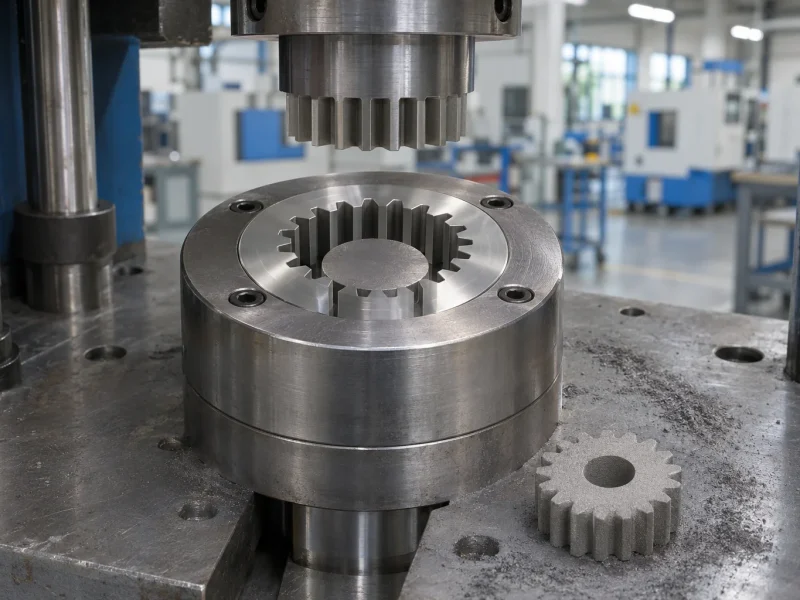
Conventional powder metallurgy (PM) presses metal powder into a shape in a rigid die, then sinters it, bonding the particles without melting the part as a whole. Parts come out close to final shape with very little material waste, which makes PM economical for gears, bushes and structural parts made in volume. A controlled amount of porosity usually remains in the part. This guide covers conventional press-and-sinter powder metallurgy.
How the process works
- Blending: metal powder is mixed with alloying additions and a lubricant.
- Compaction: the powder fills a die and is pressed by upper and lower punches, typically at around 400–800 MPa, forming a “green” compact.
- Sintering: the compact passes through a controlled-atmosphere furnace, typically around 1120 °C for iron-based parts, and the particles bond.
- Secondary operations: sizing, oil impregnation, machining, heat treatment, steam treatment or plating, where required.
Materials and density
Common materials are iron-carbon and iron-copper-carbon steels, stainless steels such as 316L, and bronze. Strength rises with density, and typical density for iron-based parts is around 6.4–7.2 g/cm³, compared with about 7.85 g/cm³ for solid steel. The remaining pores are also useful: oil-impregnated bronze and iron bushes use them to hold lubricant.
PM, MIM or machining?
| Conventional press-and-sinter PM | Metal injection molding | CNC machining | |
|---|---|---|---|
| Typical shapes | Prismatic shapes pressed along one axis | Small, complex 3D shapes | High shape flexibility, subject to tool access and workholding |
| Typical density | Lower, with some porosity | High, typically 95–99% | Full, from solid stock |
| Material waste | Very low | Low | Can be high |
| Tooling | Required | Required | Little or none |
| Economic volume | Medium to high | Medium to high | Low to medium |
Read more about metal injection molding, or compare routes on our casting, forging and powder metal page.
Design rules for pressed parts
- Design for the press axis. Undercuts and cross holes cannot release from the die and must be machined.
- Keep sections practical. Very thin walls, sharp edges and narrow fins are weak points in the tooling and the compact.
- Limit the height-to-width ratio. Powder does not flow like a liquid, so tall, narrow parts have uneven density.
- Add small chamfers and radii rather than feather edges, which protect both the punches and the part.
- Plan the density. Define the strength you need and the areas that must be dense.
Frequently asked questions
Are sintered parts as strong as machined steel?
Normally not at the same composition, because some porosity remains. Higher density, alloying and heat treatment raise the strength, and many gears and structural parts work well within those limits.
Can sintered parts be sealed?
Pores can be resin impregnated or infiltrated when a part must hold pressure or be plated. Tell us the requirement when requesting a quotation.
When does powder metallurgy make sense?
When the shape can be pressed along one axis, the volume justifies the tooling and the required strength can be met at the available density.
Talk to our engineers
Have a part to discuss? Send your drawing or 3D file through our inquiry form – our engineers reply with a quotation and DFM suggestions.
Images are illustrative.