





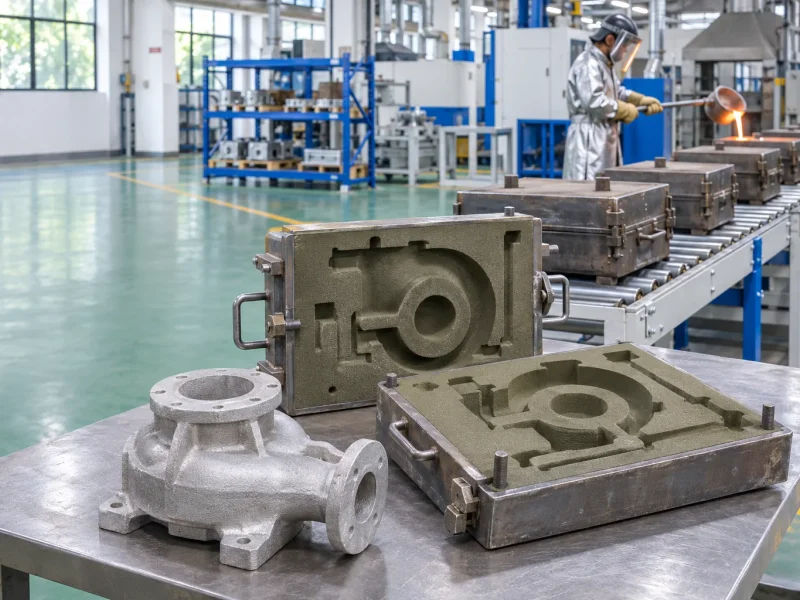
Sand casting pours molten metal into a cavity formed in compacted sand. The mould is broken away after each casting, so tooling is cheap and part size is flexible, while surface finish and tolerances are coarser than in metal-mould processes. It is usually the right choice for larger parts, low volumes and first production runs.
How the process works
- Pattern: a pattern of the part, oversized to allow for shrinkage, is made with a parting line and draft.
- Moulding: sand is packed around the pattern in two halves, the cope and the drag. Green sand is bonded with clay and moisture; resin-bonded sand gives a stronger mould and a better surface.
- Cores: separate sand cores form internal passages and hollow sections.
- Pouring: metal is poured through a gating system, with risers feeding the casting as it shrinks.
- Shake-out and cleaning: the sand is removed, gates and risers are cut off and the casting is cleaned.
- Finishing: heat treatment, machining of critical features and surface finishing, where required.
Common materials
Sand casting handles a very wide range of alloys. Common choices include aluminium alloys such as A356, grey and ductile iron, carbon and alloy steels, and copper alloys such as bronze. Metals with high melting points that would quickly damage a metal mould are a natural fit.
How it compares
| Sand casting | Gravity permanent-mould casting | High-pressure die casting | |
|---|---|---|---|
| Tooling cost | Low | Medium | High |
| Economic volume | One-off to high, depending on the moulding system | Low to medium | High |
| Part size | Very flexible, including large parts | Small to medium | Small to medium |
| Surface finish | Rough, typically machined where it matters | Good | Very good |
| Thin walls | Limited | Moderate | Very good |
The table gives general guidance. The best route depends on the part, alloy and quantity, and we review it with you at the quotation stage.
Design rules
- Add draft on faces in the direction the pattern is withdrawn, typically 1–3°.
- Keep walls even. Sudden changes in section cause shrinkage porosity and hot tears. Blend sections gradually and use generous radii.
- Allow for shrinkage and machining. Patterns are oversized for the alloy, and critical faces need extra stock to machine away.
- Avoid unnecessary cores. Each core adds cost and a possible source of variation.
- Do not expect fine detail. Small text, thin ribs and tight features are usually better machined afterwards.
What drives the cost
Pattern and core tooling usually cost less than metal dies, but they can still be a substantial share of the total cost at low volumes. The other main costs are metal weight, moulding and cleaning labour, machining and scrap risk. A part with even sections, few cores and only a few machined faces is usually the cheapest to make.
Frequently asked questions
What tolerance can sand casting achieve?
It is coarser than metal-mould casting and depends on size, alloy and moulding method. ISO 8062 grades in the region of CT 8 to CT 13 are typical. Faces that must be accurate should be machined.
Is sand casting suitable for prototypes?
Yes, particularly when the prototype must be cast metal. Note that a later move to die casting can change the alloy and the design, so results do not always carry over directly.
Can sand castings be heat treated?
Yes, many sand cast alloys can be, including heat-treatable aluminium alloys such as A356 and steels. The right treatment depends on the alloy and the required properties.
Talk to our engineers
Have a part to discuss? Send your drawing or 3D file through our inquiry form – our engineers reply with a quotation and DFM suggestions.
Images are illustrative.