





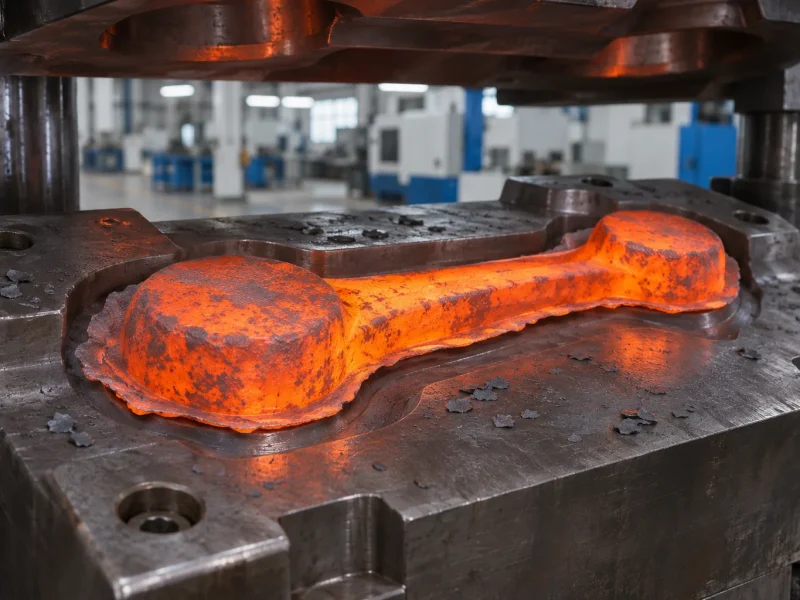
Forging shapes solid metal with compressive force instead of melting it. The result is a dense part with a grain flow that follows its shape, which is why forging is widely used for parts carrying high or repeated loads. Forged shapes are simpler than castings, so fine details are usually machined afterwards.
Main forging methods
- Closed-die (impression-die) forging: heated metal is pressed between two dies containing the shape of the part. Excess metal escapes as flash and is trimmed off. It suits medium and high volumes.
- Open-die forging: metal is worked between flat or simple dies without being fully enclosed. It suits large parts, simple shapes and low volumes, with little tooling.
- Cold forging: metal is formed at or near room temperature, giving good surface finish and accuracy on smaller, simpler parts, but it needs higher forces.
In hot forging, steel is typically heated to around 1100–1250 °C so that it flows easily. Scale forms on the surface and is removed by shot blasting.
Forging, casting or machining?
| Forging | Casting | Machining from bar | |
|---|---|---|---|
| Internal soundness | Dense, no casting porosity | Depends on process and control | Same as the bar stock |
| Grain flow | Follows the part shape | No directional flow | Cut through by machining |
| Shape complexity | Moderate | High | High, but at a cost |
| Tooling | Dies for closed-die work | Pattern, die or mould | Little or none |
| Material utilisation | Varies: flash, scale and machining allowance | Varies: gates, risers and machining allowance | Can be low, with chips recyclable |
Material use depends on the geometry and the process, and much of the metal removed in forging and casting can be recycled.
Common materials
Common forging materials include carbon steels such as 1045, alloy steels such as 4140, stainless steels such as 304 and 316, aluminium alloys such as 6061, and brass. The choice depends on strength, toughness, corrosion resistance and the heat treatment that follows.
Design rules for closed-die forging
- Choose the parting line early. It sets the flash line and affects grain flow and die design.
- Add draft, typically 3–7° on steel, so that the part releases from the die.
- Use generous radii. Sharp corners restrict metal flow and shorten die life.
- Avoid thin webs and tall narrow ribs. They cool quickly and are hard to fill.
- Leave machining stock on critical faces, allowing for scale and the flash line.
Frequently asked questions
Is forging always stronger than casting?
For the same alloy, a forged part generally has better fatigue strength and toughness because it is dense and has directional grain flow. A well-made casting can still be the better choice where the loads are moderate and the shape is complex.
Do forged parts need machining?
Usually on critical surfaces. Bores, bearing seats, threads and mating faces are normally machined, while other surfaces can stay as forged.
When is forging worth the tooling cost?
When the part carries high loads or the volume is enough to spread the die cost. For very small quantities, machining from bar or open-die forging may be more economical.
Talk to our engineers
Have a part to discuss? Send your drawing or 3D file through our inquiry form – our engineers reply with a quotation and DFM suggestions.
Images are illustrative.