





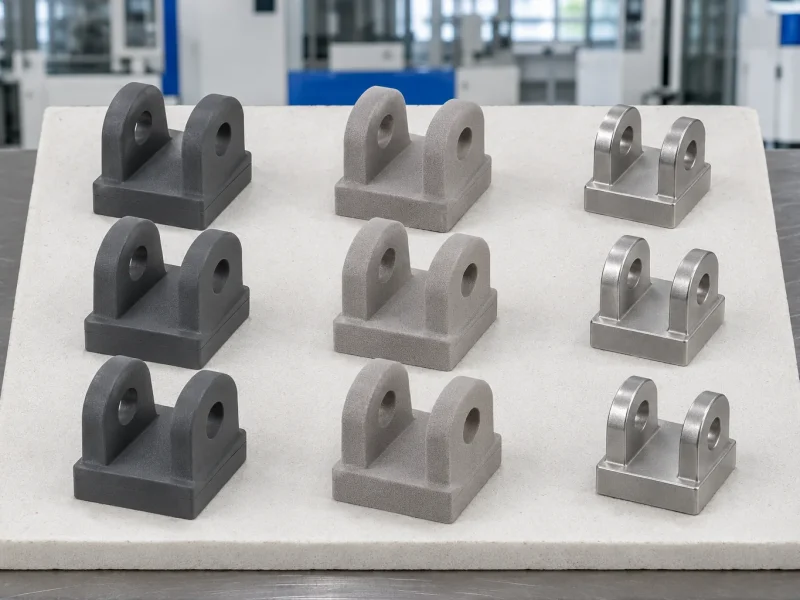
Metal injection molding (MIM) mixes fine metal powder with a binder, injects the mixture into a mould like a plastic, removes the binder and sinters the part to high density. It suits small, complex metal parts needed in volume. Typical linear shrinkage from the moulded part to the sintered part is around 15–20%, so the mould is made oversized and sintering supports are designed to control distortion.
How the process works
- Feedstock: fine metal powder is mixed with a polymer and wax binder and formed into pellets.
- Moulding: the feedstock is injected into a mould on an injection moulding machine, forming a “green” part that holds its shape but is fragile.
- Debinding: most of the binder is removed with a solvent, a catalyst or heat, leaving a porous “brown” part.
- Sintering: the part is heated in a controlled furnace close to the melting point of the alloy, often around 1300–1400 °C for stainless steels. It shrinks and reaches high density.
- Secondary operations: sizing, machining, heat treatment or surface finishing, where required.
Common materials
Common materials include stainless steels such as 316L and 17-4PH, low-alloy steels such as 4605, and, for specialised uses, soft magnetic alloys and tungsten alloys. Typical density after sintering is around 95–99% of the solid material, so mechanical properties are close to those of wrought material.
When to choose MIM
| MIM | Investment casting | CNC machining | Conventional press-and-sinter PM | |
|---|---|---|---|---|
| Part size | Small | Small to large | Wide range, limited by machine capacity | Small to medium |
| Shape freedom | High | High | High, subject to tool access | Limited by pressing |
| Fine detail | Very good | Good | Very good | Limited |
| Tooling cost | High | Medium | Little or none | Medium |
| Economic volume | High | Low to high | Low to medium | Medium to high |
As a rule of thumb, MIM becomes worth considering when the part is small, typically well under about 100 g, its shape is hard to machine and the quantity can repay the mould. Read our powder metallurgy guide and investment casting guide for the alternatives.
Design rules
- Keep walls thin and even. Thick sections slow debinding and can distort. Core out heavy areas where possible.
- Use radii and fillets to help the feedstock flow and to reduce stress.
- Add draft where possible, particularly on long cores, so the fragile green part can be ejected.
- Plan for support. The part sits on a setter during sintering, so a flat surface helps to prevent sagging.
- Allow machining on critical features. As-sintered tolerances are typically around ±0.3–0.5% of the dimension, so very close fits usually need sizing or machining.
- Agree the gate location with us. A gate mark remains on the part.
Frequently asked questions
How is MIM different from conventional powder metallurgy?
MIM is a branch of powder metallurgy. Unlike conventional press-and-sinter PM, it injection-moulds a powder and binder feedstock before debinding and sintering. This gives more shape freedom and higher density, and suits smaller parts.
Are MIM parts as strong as machined parts?
They can come close, because density after sintering is typically high and the part can be heat treated, depending on the alloy. Compare the data for the alloy and condition you need against your requirement.
Why not machine the part instead?
At low volumes, machining is usually better because it needs no mould. MIM makes more sense as quantity and shape complexity rise.
Talk to our engineers
Have a part to discuss? Send your drawing or 3D file through our inquiry form – our engineers reply with a quotation and DFM suggestions.
Images are illustrative.