





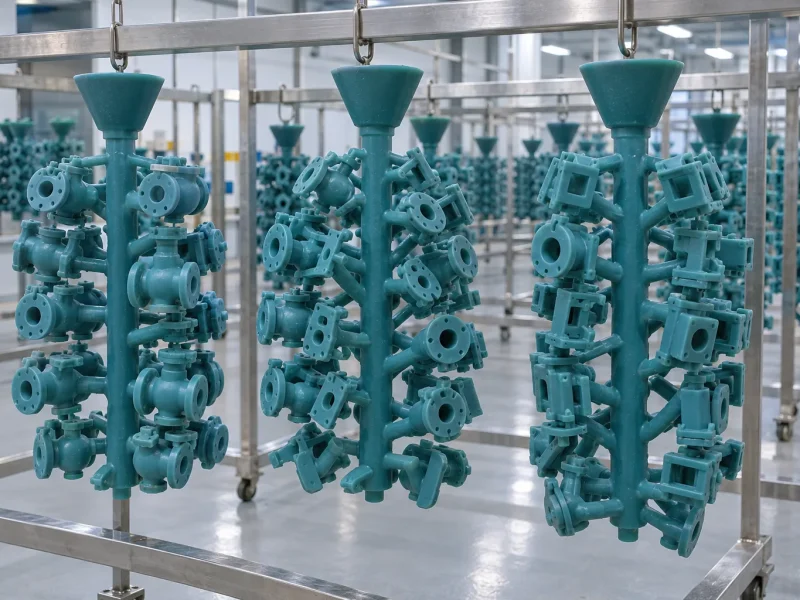
Investment casting makes a wax copy of the part, coats it in a ceramic shell, melts out the wax and pours metal into the hollow shell. Because there is no parting line to release from, it can produce complex shapes with fine detail and a good as-cast surface. Tooling costs more than sand casting patterns but usually less than a die casting die.
The process step by step
- Wax pattern die: a metal die is made, sized to allow for the shrinkage of both wax and metal.
- Wax injection: wax is injected into the die to form one pattern for each casting.
- Tree assembly: patterns are attached to a central wax sprue, forming a cluster or “tree”.
- Shell building: the tree is dipped in ceramic slurry and coated with sand, then dried. This is repeated, typically five to nine times, until the shell is strong enough.
- Dewaxing: the wax is melted out, leaving a hollow ceramic shell.
- Firing and pouring: the shell is fired and molten metal is poured into it while it is hot, which helps thin sections fill.
- Knock-out and cut-off: the shell is broken away and the castings are cut from the tree.
- Finishing: gate grinding, heat treatment, machining and surface treatment, where required.
Silica sol and water glass shells
The shell binder has a large effect on the result. Silica sol shells generally give a finer surface and closer tolerances, and water glass shells cost less. Typical as-cast tolerance grades are around ISO 8062 CT 4–6 for silica sol and CT 7–9 for water glass, depending on size and shape.
When to choose it
| Choose investment casting when… | Consider another route when… |
|---|---|
| The shape is complex and would need heavy machining | The part is simple and easy to machine from bar |
| The alloy is steel or stainless steel | The part is a thin-walled aluminium or zinc part in high volume (die casting) |
| A good as-cast surface reduces finishing | The part is very large (sand casting) |
| Moderate tooling cost is acceptable | The part carries very high loads and needs forged properties |
Design tips
- Keep wall thickness even and blend changes in section, so that metal can feed the part as it solidifies.
- Use radii at internal corners to reduce stress and hot spots.
- Limit deep, narrow holes. The shell must reach inside them, so small blind holes are often better machined.
- Mark datums and critical faces so that machining stock can be allowed in the right places.
Frequently asked questions
Does investment casting need draft?
Very little on the casting itself, because the shell is broken away. Wax patterns must still release from the die, so a small draft or a die insert may be needed in some areas.
Is investment casting more expensive than sand casting?
Usually per part, because the process has more steps. It can still cost less overall when it removes machining or gives a surface that needs no further work.
Can investment cast parts be machined?
Yes. Critical faces, bores and threads are commonly machined after casting and heat treatment.
Talk to our engineers
Have a part to discuss? Send your drawing or 3D file through our inquiry form – our engineers reply with a quotation and DFM suggestions.
Images are illustrative.