





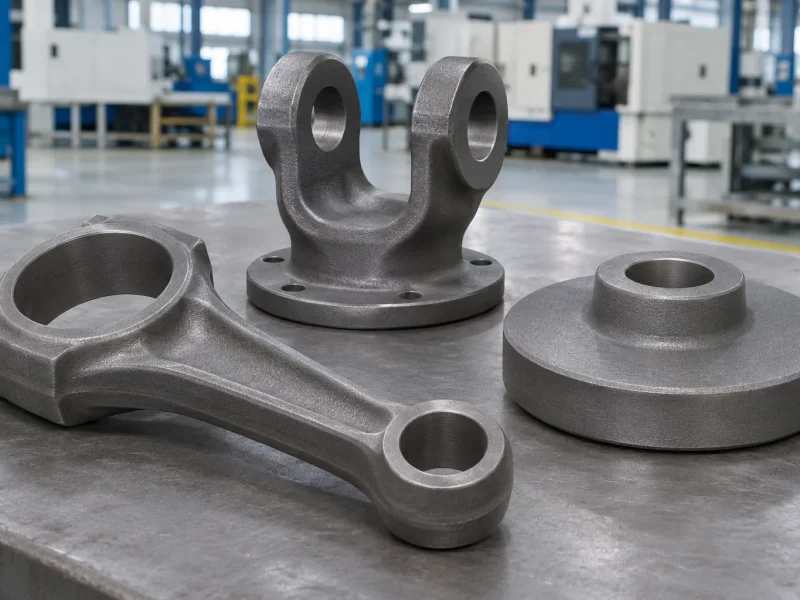
Answers to common questions about metal forging. For more detail, read our forging guide.
What is metal forging?
A process that shapes solid metal with compressive force, using hammers or presses and, in most production work, shaped dies. The metal is not melted.
What is the difference between hot and cold forging?
Hot forging heats the metal so that it flows easily, allowing larger and more complex shapes. Cold forging works near room temperature and gives a better surface and accuracy, but needs higher forces and suits smaller, simpler parts.
What is flash on a forging?
Excess metal squeezed out between the dies at the parting line in closed-die forging. It is trimmed off afterwards, and a faint trim line usually remains.
Why does grain flow matter?
In a forging, the grain structure follows the shape of the part. This improves fatigue strength and impact toughness, particularly where loads pass through corners and changes of section.
Which materials can be forged?
Common choices are carbon and alloy steels, stainless steels, aluminium alloys and brass. Tell us the grade you need or the service conditions.
Are forgings heat treated?
Often. Normalising, quenching and tempering or solution treatment can set the final properties, depending on the alloy. Heat treatment is normally planned together with machining.
Can you supply forgings machined and finished?
Yes. A forging can be supplied as an intermediate part or taken through machining, deburring, heat treatment, finishing and assembly.
What do you need for a quotation?
A 3D file and drawing, the material grade, annual quantity, and any heat treatment, finish or test requirements.
Talk to our engineers
Have a part to discuss? Send your drawing or 3D file through our inquiry form – our engineers reply with a quotation and DFM suggestions.
Images are illustrative.