





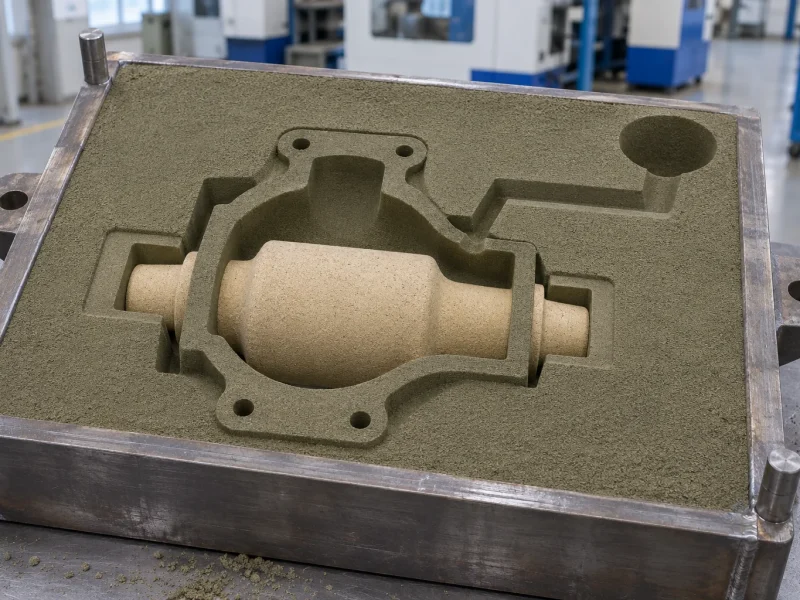
Answers to common questions about sand casting. For a fuller explanation, read our sand casting guide.
What is sand casting?
A casting process in which molten metal is poured into a cavity formed in compacted sand. The sand mould is broken away after each casting and the sand is typically reclaimed.
When should I choose sand casting?
For larger parts, low volumes, first production runs and alloys with high melting points. For suitable non-ferrous alloys, gravity permanent-mould casting or die casting may become more economical as volume increases.
What is the difference between green sand and resin sand?
Green sand is bonded with clay and moisture and is quick and economical. Resin-bonded sand gives a stronger, more rigid mould, usually with better dimensional control and a better surface, at a higher material cost.
What causes porosity in sand castings?
Mainly trapped gas and shrinkage as heavy sections solidify. Good gating and risers, even wall thickness and controlled melting all reduce it. Tell us which areas must be pressure-tight or free of defects.
How rough is a sand cast surface?
It is rougher than a die cast or investment cast surface and shows the sand grain. Finer sand and coatings improve it. Blasting is commonly used for cleaning and appearance, while sealing faces usually need machining to the specified flatness and surface finish.
Can you machine the castings as well?
Yes. A sand casting can be supplied as cast or taken through machining, heat treatment, finishing and assembly. See our CNC machining and surface finishing pages.
What do you need for a quotation?
A 3D file and drawing, the alloy, annual quantity, and any heat treatment, finish or test requirements. It also helps to mark the critical faces.
Talk to our engineers
Have a part to discuss? Send your drawing or 3D file through our inquiry form – our engineers reply with a quotation and DFM suggestions.
Images are illustrative.